Posts

Showing posts with the label CBSE

Class X Session 2023-24 Question 28

MATH SAMPLE QUESTION PAPER Class X Session 2023-24 MATHEMATICS STANDARD (Code No.041) Question 28 The sum of a two digit number and the number obtained by reversing the digits is 66. If the digits of the number differ by 2, find the number. How many such numbers are there? Explanation:   \begin{flalign} & Let's\; consider\; the \; unit\; digit\; be\; a\; and \; ten\; digit\; be \; b\; &\\ & so, Original \; number \; is\; a+10b ---(1) \; where\; a\; \neq b &\\ & By \;reversing\; the\; digit\,\; we\; get\; 10b+a ----(2) &\\ & According \;to\; the\; question\;,\; we \; get & \\ & (a+10b) + (10b+a) = 66 &\\ &\Rightarrow 11a +11b = 66 & \\ & or \; a+b = 6 --(3) & \\ & since\; given \; that\; digit \;of \;the\; number \;differ \;2 &\\ & \therefore a-b = 2 ---(4) &\\ & by \; adding \; equations \;2\; and \;3\; we \;get &\\ & (a-b) +(a+b) = 2+6 &\\ & 2a = 8 &\\ & \therefore a = 4 ...

Class X Session 2023-24 Question 27

 MATH SAMPLE QUESTION PAPER Class X Session 2023-24 MATHEMATICS STANDARD (Code No.041) Question 27 \begin{flalign} & if\;,\;\alpha\; \beta \; are \; Zeroes \; of \; quadratic\;polynomial\; 5x^2 + 5x + 10 \;find \; the\; value\; of\; (1) \;\alpha^2\;+ \beta^2 \; ,\;(2)\;\alpha^-{1} + \beta^-{1} &\ \end{flalign} Explanation:   \begin{flalign} & since\; \alpha\; and \; \beta\; are \;the \;root\; of\; 5x^2 + 5x + 10 as \;we \;know\; that\; if \; quadratic\; equation;&\\ & ax^2 + bx +c =0 \;then \; SUM \;of \; zeroes\; \alpha + \beta\ = -\frac{b}{a}; and \;product\; of \;Zeroes\; =\; \frac{c}{a}&\\ & since\; \alpha\; and \; \beta\; are \;the \;root\; of\;5x^2 + 5x + 10 \;similarly \;\ from\; the \;given\; equation\; \alpha + \beta = & \\ & \frac{-5}{5} and \; \alpha \beta \;= \frac{1}{5} , \; now \; lets \;find\; \alpha^2 + \beta^2 &\\ &\Rightarrow (\alpha + \beta)^2 = \a...

Class X Session 2023-24 Question 26

Image
 MATH SAMPLE QUESTION PAPER Class X Session 2023-24 MATHEMATICS STANDARD (Code No.041) Question 26 Find the area of the unshaded region shown in the given figure.  Solution: modified view of shared image The total horizontal or vertical extent of the region is 8 cm and extent includes the side length of the square (𝑎)  and the diameters of the semicircles on either side of the square. Given that each semicircle has a radius 𝑟, the side length of the square is 𝑎=8−2𝑟. Given the figure, the radius 𝑟 of each semicircle is 2cm Side Length of the Square 𝑎 = 8-2x2  = 4 cm Area of the Square:  𝑎^2 = 4^2 = 16 Area of One Semicircle = \[ \frac{1}{2} {\pi} r^2 = 2{\pi} \; cm^2\; where \; r= 2 \] Combined Area of Four Semicircles: \[4\times 2\pi\; cm^2\] Area of the unshaded region=Area of the square + 4 x Area of  one semicircle = \[16 \; cm^2 + 4 \times2 {\pi} \; cm^2 \] \[(\;16 + 8{\pi}\;) \; cm^2\] 

Class X Session 2023-24 Question 25

 MATH SAMPLE QUESTION PAPER Class X Session 2023-24 MATHEMATICS STANDARD (Code No.041) Question 25 Find the value of x if \begin{flalign} & 2\;cosec^2(30) + xsin^2(60)-\frac{3}{4}tan^2(30)= 10 &\ \end{flalign} Explanation:    Now simplify the equation below  \begin{flalign} & 2\;cosec^2(30) + xsin^2(60)-\frac{3}{4}tan^2(30)= 10 &\\ \end{flalign} \[ \Rightarrow 2\times(2)^2+ x\left(\frac{\sqrt{3}}{2}\right)^2 -\frac{3}{4}\left(\frac{1}{\sqrt{3}}\right)^2 = 10 \] we know that value of cosec(30) , sin(60)and tan(30) putting their values \[ \Rightarrow 2\times 4 + x\frac{3}{4} - (\frac{3}{4}\times\frac{1}{3} )= 10 \] \[ OR \; 8 + \frac{3x}{4} - \frac{1}{4} = 10 \] \[ OR \; \frac{3x}{4} = \frac{1}{4} +(10-8) \] \[ OR \; \frac{3x}{4} = \frac{1}{4} +2 \Rightarrow \frac{9}{4} \] \[ OR \; \frac{3x}{4} = \frac{9}{4} \] \[\Rightarrow {3x} = {9} \] \[\therefore{x} = {3} \]

Class X Session 2023-24 Question 24

 MATH SAMPLE QUESTION PAPER Class X Session 2023-24 MATHEMATICS STANDARD (Code No.041)  Question 24 \[if\; \tan(A + B) =\;\sqrt{3} \; and \;\tan(A - B) =\;\frac{1}{\sqrt{3}}\] , 0° < A + B < 90°; A > B, find A and B. Explanation:   Given that : \[ \tan(A + B) =\;\sqrt{3} \; and \;\tan(A - B) =\;\frac{1}{\sqrt{3}}\] First, recognize the angles for which \[\tan(\theta) = \sqrt{3} \; and \; tan(\theta) = \frac{1}{\sqrt{3}}\] we know that \[\tan(60^{\circ}) = \sqrt{3} \; and \; tan(30^{\circ}) = \frac{1}{\sqrt{3}}\] \[\ so,\; A+B \;= 60^{\circ} \; and \; A-B \;= 30^{\circ}\] now add the two equation , we get  \[\ A+B \;= 60^{\circ},---(1)\]  \[\ A-B \;= 30^{\circ},---(2)\] \[\ so,\;(A+B)+(A-B)\;= 60^{\circ} + 30^{\circ}\] \[\ or,\;2A\;= 90^{\circ}\] \[\ or,\;A\;= 45^{\circ}\] Now Put A value in equation (1) and we get  \[\ from (1),\;B\;= 60^{\circ} - 45^{\circ}\] \[\therefore \; B\;= 15^{\circ}\] \[Now \; A\;= 45^{\circ}\; and \; B\;= 15^{\circ}\...

Class X Session 2023-24 Question 21

Image
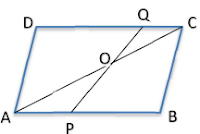
 MATH SAMPLE QUESTION PAPER Class X Session 2023-24 MATHEMATICS STANDARD (Code No.041) SECTION B -  Question 21 ABCD is a parallelogram. Point P divides AB in the ratio 2:3 and point Q divides DC in the ratio 4:1. Prove that OC is half of OA. Explanation : ABCD is a parallelogram. we know that AB = DC let AB = l then AB = DC = l given that Point P divides AB in the ratio 2:3 \[\Rightarrow AP = \frac{2}{5}\times l;and\;BP \;=\frac{3}{5}\times l \] \[Since\; we \;considered\; AP + BP = AB = l \] \[\Rightarrow DQ = \frac{4}{5}\times l;and\;CQ \;=\frac{1}{5}\times l \] given that point Q divides DC in the ratio 4:1 \[Since \; DQ + CQ = DC= l \] As we know that [AA similarity] \[\therefore ∆ APO \thicksim ∆ CQO \] \[\therefore \frac{AP}{CQ} = \frac{PO}{QO} = \frac{AO}{CO} \] \[\therefore \frac{AO}{CO} = \frac{\frac{2}{5}\times l}{\frac{1}{5}\times l} = \frac{2}{1} \] After simplifying the above equation, we get \[\Rightarrow OC = \frac{1}{2} \times AO \]

Class X Session 2023-24 Question 19

 MATH SAMPLE QUESTION PAPER Class X Session 2023-24 MATHEMATICS STANDARD (Code No.041) Question 19 DIRECTION: In the question number 19 and 20, a statement of assertion (A) is followed by a statement of Reason (R). Choose the correct option Statement A (Assertion): Total Surface area of the top is the sum of the curved surface area of the hemisphere and the curved surface area of the cone. Statement R( Reason) : Top is obtained by joining the plane surfaces of the hemisphere and cone together (a) Both assertion (A) and reason (R) are true and reason (R) is the correct explanation of assertion (A)  (b) Both assertion (A) and reason (R) are true and reason (R) is not the correct explanation of assertion (A) (c) Assertion (A) is true but reason (R) is false. (d) Assertion (A) is false but reason (R) is true.  Explanation :  (b) Both assertion (A) and reason (R) are true and reason (R) is not the correct explanation of assertion (A) Statement A (Assertion) is true becaus...

Class X Session 2023-24 Question 18

Image
 MATH SAMPLE QUESTION PAPER Class X Session 2023-24 MATHEMATICS STANDARD (Code No.041) Question 18 The upper limit of the modal class of the given distribution is: (a) 165  (b) 160  (c) 155  (d) 150 Explanation :  The class interval  Below 165 has the highest frequency of 51 girls. To find the upper limit of this class interval, we consider that the class interval "Below 165" starts from 160 and ends at the upper limit of the class interval before it. So, the upper limit of the modal class Below 165 is Upper limit = 165  Upper limit=165. Guess the Option and comment below   👇

Class X Session 2023-24 Question 16

Image
 MATH SAMPLE QUESTION PAPER Class X Session 2023-24 MATHEMATICS STANDARD (Code No.041) Question 16 There is a square board of side ‘2a’ units circumscribing a red circle. Jayadev is asked to  keep a dot on the above said board. The probability that he keeps the dot on the shaded  region is. \begin{flalign} (a)\;\;& \frac{\pi}{4}\\ (b)\;\;& \frac{4-\pi}{4}&\\ (c)\;\;& \frac{\pi - 4}{4}&\\ (d)\;\;& \frac{4}{\pi}&\\ \end{flalign} Explanation :  Given that , The square board has side length 2a  units and the board circumscribes a red circle. The shaded region represents the area within the square board but outside the red circle. so we have to find the ratio of the area of the shaded region to the total area of the square board. we know that area of the square is side^2  => 4a^2 square units. similarly  area of the red circle   => π(radius)^2 = π(a)^2 \[\therefore Area \; of\; shaded\; r...

Class X Session 2023-24 Question 14

 MATH SAMPLE QUESTION PAPER Class X Session 2023-24 MATHEMATICS STANDARD (Code No.041) Question 14 If the perimeter and the area of a circle are numerically equal, then the radius of the circle is (a) 2 units  (b) π units  (c) 4 units  (d) 7 units Explanation :  This question is really easy to answer. The perimeter of a circle (circumference) is given by 2𝜋𝑟 where 𝑟 is the radius. The area of a circle is given by 𝜋𝑟^2, where 𝑟 is the radius Given that the perimeter and the area are numerically equal, we can set up the equation \[ given \; that\; {2πr \; = 2π(r)^2} \] To solve for 𝑟, we can divide both sides of the equation by \[ \Rightarrow  {r} \; = 2 \; units \] Guess the Option and comment below   👇

Class X Session 2023-24 Question 12

 MATH SAMPLE QUESTION PAPER Class X Session 2023-24 MATHEMATICS STANDARD (Code No.041)  Question 12 (sec A + tan A) (1 – sin A) equals : (a) sec A  (b) sin A  (c) cosec A  (d) cos A Explanation :  let's first express  sec A and tan A in terms of sinA and cos A We know that  \[sec A \; =\; \frac{1}{cos A }\]  \[tan A \; =\; \frac{sin A}{cos A }\]  \[(secA+tanA)(1−sinA) \; = (\frac{1}{cosA} + \frac{sinA}{cosA}) \;(1−sinA) \] \[\Rightarrow (\frac{1+sinA}{cosA})(1−sinA) \] Now, let's expand this expression \[\Rightarrow \frac{(1+sinA)(1-sinA)}{cosA} \] \[\Rightarrow \frac{(1-sin^2A)}{cosA} \] \[we\; know \;that \; { 1-cos^2A} \;=\; sin^2A, 💡  \] \[\therefore \frac{(cos^2A)}{cosA} \; =\; cosA \] Guess the Option and comment below   👇

Class X Session 2023-24 Question 10

Image
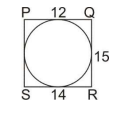
 MATH SAMPLE QUESTION PAPER Class X Session 2023-24 MATHEMATICS STANDARD (Code No.041)  Question 10   A quadrilateral PQRS is drawn to circumscribe a circle the tangent  If PQ = 12 cm, QR = 15 cm and RS = 14 cm, then find the length of SP is (a) 15 cm  (b) 14 cm (c) 12 cm  (d) 11 cm Explanation :  A circle is inscribed inside the quadrilateral, such that each side of the quadrilateral is tangent to the circle.  Now, in a cyclic quadrilateral, the opposite angles are supplementary Given that PQRS is a cyclic quadrilateral,  \[ \therefore PQ + RS = QR + SP,-----(a) \] Given that  PQ=12 cm QR=15 cm RS=14 cm  and putting eq(a) \[ \therefore 12+14=15+SP \] \[ \therefore SP=26−15 \] \[ \therefore SP=11 \] Guess the Option and comment below   👇

Class X Session 2023-24 Question 9

Image
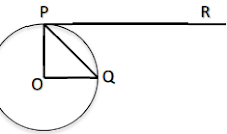
 MATH SAMPLE QUESTION PAPER Class X Session 2023-24 MATHEMATICS STANDARD (Code No.041)  Question 9  If O is centre of a circle and Chord PQ makes an angle 50° with the tangent PR at the point of contact  P, then the angle subtended by the chord at the centre is (a) 130°  (b) 100°                                                               (c) 50°    (d) 30° Explanation :  OP ⊥ PR   [.. it indicates that the line segment 𝑂𝑃 is perpendicular to the line 𝑃𝑅 ] ∠OPQ = 90° – 50° = 40° OP = OQ   ...[Radii] ∴ ∠OPQ = ∠OQP = 40° In ΔOPQ,  ∠POQ + ∠OPQ + ∠OQP = 180° [.. applied the angle sum property ]  ∠POQ + 40° + 40° = 180°  ∠POQ = 180° – 80° = 100° Guess the Option and comment below   👇

Class X Session 2023-24 Question 8

Image
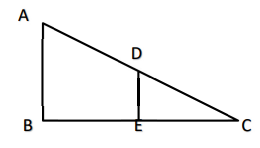
 MATH SAMPLE QUESTION PAPER Class X Session 2023-24 MATHEMATICS STANDARD (Code No.041)  Question 8  In 𝛥 ABC, DE ‖ AB. If AB = a, DE = x, BE = b and EC = c Then x expressed in terms of a, b and c is: \begin{flalign} (a)\;\;& \frac{ac}{b}\\ (b)\;\;& \frac{ac}{b+c} \\ (c)\;\;& \frac{ab}{c}\\ (d)\;\;& \frac{ab}{b+c}&\\ \end{flalign} Explanation :  \begin{flalign} Since \; DE\;&\Vert \; AB \; we \;can \;similar \; \triangle \; find \;the\; length&\\ \end{flalign} Using the properties of basic proportionality theorem we have  \begin{flalign} &\triangle \; CDE \; \sim \; \triangle \; CAB \ \end{flalign} \[\Rightarrow \; \frac{CE}{CB} =\frac{DE}{AB}\] \[OR \; \frac{CE}{BE + EC} =\frac{DE}{AB}\] \[\Rightarrow \; \frac{c}{b+c} =\frac{x}{a}\] \[OR \; \; {x} =\frac{ac}{b+c}\;...by \; cross \; multiplication\]   Guess the Option and comment below   👇

Class X Session 2023-24 Question 2

Image
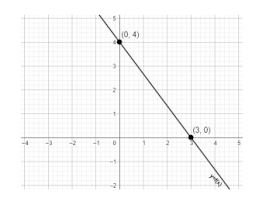
                                                                  MATH SAMPLE QUESTION PAPER Class X Session 2023-24 MATHEMATICS STANDARD (Code No.041) Question 2 The given linear polynomial y = f(x) has  (a) 2 zeros  (b) 1 zero and the zero is ‘3’  (c) 1 zero and the zero is ‘4’  (d) No zero   Explanation : A linear polynomial has the form y=mx+c, where m is the slope and c is the y-intercept. Since it's a linear polynomial, it represents a straight line. The number of zeros of a linear polynomial is the number of points where it intersects the x-axis .    If the slope ( m ) is not zero, the line will intersect the x-axis at exactly one point, unless it is parallel to the x-axis, in which case it will never intersect the x-axis. If the...

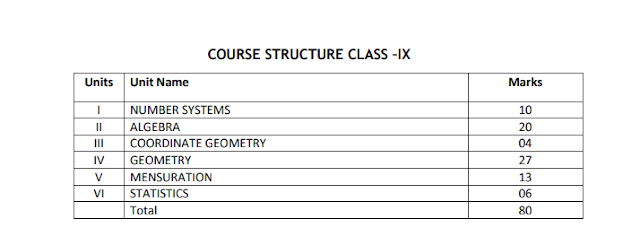
CBSE Maths 2024-2025 Curriculum

Image
 CBSE MATHEMATICS (IX-X):